The outward transmutation in the alchemical process of converting base metal to gold mirrors an inner journey to completeness. This necessitates an underworld quest to bring forth chthonic forces up into the crisp transformative light of awareness.
There is a guttural dark other half to us kept under wraps. This is the unfelt legion of the unacceptable, those feelings of primordial fear, instinctual lust, shame, anger and grief that lurk beneath in the shadowland, secretly buried and kept away. Without openness and acceptance these energetic feeling tones will haunt us. They may even hunt us as we attempt to hide in the ubiquitous distractions of our age. Our desperate turning away only gives them strength.
The alchemical work of the unification of this dark other half requires the prerequisite of an alchemical vessel, a safe container through which change can happen. In psychotherapy this is the client therapist dyadic relationship. In the model of therapy I have trained in, the therapist creates a ‘holding field’. Here, the emphasis is on love and compassion, and the term ‘holding’ is suggestive of maternal energy. All children need to be held in times of distress and anguish to facilitate nervous system regulation. In therapy this regulation is not achieved by a physical holding but rather it is maintained through a ‘field’ of safety, trust and emotional containment. In this way, the client can securely explore their shadowland.
Sometimes it is said that the therapist ‘holds the space’ but what exactly is meant by ‘space’ in this context? When we think of space, we usually conceptualise Euclidean space which is the familiar physical space within which we exist. For example, right now, I am sitting at my lamp-lit desk in my converted garage. But this kind of space posits itself within a deeper more fundamental space – the space of mind. The interior experience of our thoughts and emotions, as well as our outer experience through the senses, all happen within this space.
This spaciousness is not a creation. We cannot bring it into existence because it is already there and as such it is the only constant we have. Life is in continual dynamic change and flux. The internal world of our thoughts, feelings and emotions, as well as apparent external world of objects, are all subject to change. Nothing is immune to decay and transmutation except, that is, the spacious arena in which life itself unfolds. Everything that happens, happens somewhere, and that somewhere is the space of the mind which remains untouched, pure and crystalline no matter what happens within it.
How does this space relate to the alchemical process of integration? To answer this, I will invoke the Buddhist notion of suffering and happiness. Suffering is referred to as Dukha and happiness is referred to as Sukha. Winthrop Sargant[1] writes:
“The ancient Aryans who brought the Sanskrit language to India were a nomadic people who travelled in horse drawn vehicles. Su and dus are prefixes indicating good or bad. The word kha, in later Sanskrit meaning ‘sky’, ‘ether’, or ‘space’, was orginally the word for ‘hole’, particularly an axle hole of one the Aryan’s vehicles. Thus, sukha meant originally, ‘having a good axle hole’, while dukkha meant ‘having a poor axle hole’, leading to discomfort.”
I like to view the movement of the cartwheel as a symbolic representation of the dynamic ebb and flow our experience as described earlier. If we are not in accordance with the ethereal sky-like spacious nature of mind, the central axel hole of the wheel of our experience is faulty and grates, the energetic flow is hindered, and we suffer as a result. We grasp onto that which we like and push away that which is unacceptable. We also solidify the space of the axel hole into a concrete sense of self and then mistakenly believe we are the primary centre of the world, but we are not – the space is. It is this misalignment that causes us so much untold suffering.
As mentioned, Sukha is often translated as happiness. But I feel this is a misnomer. Yes, when we are in accordance with space we are in a state of flow which can be experienced as happiness or even blissfulness but, for me, this is does not quite encapsulate the full meaning of Sukha. Being in alignment with space means being in accordance with the entire spectrum of our sensitivity, not just what we consider pleasurable. We also need to be open to what we consider displeasing, painful and hurtful. It other words, we need to be open to our shadow, those parts of us we either consciously or unconsciously dare not face.
There is a kind of bliss enfolded within the dark recesses of our shadow - glittering exquisite gold buried in the muck. Take grief as an example. Grief can eat us up inside. It can lodge itself in our bodies residing just out of reach. We can be terrified of its full intensity and resist its urge for expression because it feels like it may consume our very being. It is just too painful to face. But then, given the right circumstances, we give those petrifying feeling tones space. If we just let it be there rather than resist it, this affective energetic force bubbles up and bursts forth in a cathartic release. A pressure valve is released. We feel lighter, as if a mist has cleared and we can relax. We feel more stable, centred and grounded. This process is equally a kind of bliss.
Thus, spaciousness is the alchemical catalyst that facilitates shadow integration. This is because it has a Hermetic quality. Hermes is the only Greek god that has unrestricted access to all the realms – the Olympian realm of the gods, our mortal world and the underworld of Hades. Similarly, spaciousness is the interconnective thread that is the portal between the conscious and unconsciousness mind. If we relax into space, we are relaxing into liminality allowing for unconscious material will rise into awareness. It is the connecting principle.
What can a therapist do to encourage this process? All a therapist can do is embody the space within their own stream of experience and the only way to do this is to through a path of meditation. The recognition of spaciousness is a lifelong quest into the event horizon of our mind. This is a spiral-like descent into the depths of an unfathomable mystery because no-one knows what this space is, it is completely and utterly formless. Despite the impossibility of knowing what this formlessness is, it does not mean we cannot rest in it. We can acquaint and familiarise ourselves with not knowing. In time we might be able to have enough faith and confidence to completely surrender - to finally relax into the formless spacious hub in the wheel of our experience to allow the world to unfold and flow on its own accord.
This mysterious formlessness is the basis through which therapeutic change happens. I will use the symbology of the Magician Tarot card to demonstrate this[2].
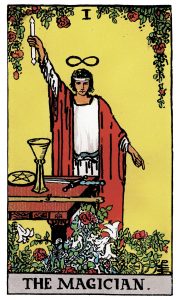
In this card the magician is holding a white double-ended wand in his right hand which is pointing up. He is standing before a table with magical apparatus splayed out. In psychotherapy, the magical apparatus is the therapist’s toolkit, his interventions and knowledge about matters related to mental health such as attachment theory, psychoanalysis and somatic experiencing. However, it is a mistake to think that this is what ultimately enables change in the client. The real power is not in the tricks of the trade but rather it is in the connection with the ineffable, unknowable, formless beyond, that is symbolised by the wand which points upward to the spacious sky. This is where the real power resides. There are no mechanisms as to how this works because non-conceptual formlessness is a dimensionless point of intersection, not only between the unconscious and conscious mind, but also between the therapist and client. From this perspective, the therapist does not cause a change in the client because in spaciousness there is no differential between the two. They both share the same source - the therapist does not ‘hold the space’ but rather the space holds the therapist and the client in non-duality.
Under the surface of appearances, in the space of non-duality, a heart connection is fostered because it is the true meeting place between self and other. This does not happen through the therapist doing interventions but rather through a process of resting and feeling. To have trust in not-knowing and allow the energetic movements to unfurl on their accord in interconnectivity. To patiently open to the others pain and misery. This is true compassion. Over time a bond is coalesces in the ground of being that provides a safe environment for the client to take risks and explore their shadowland. This is the alchemical space through which change can happen.
[1] Sargant, Winthrop (2009), The Bhagavad Vita p303, SUNY Press
[2] I owe this insight to Duncan Barford on his podcast Hierophany.