The Integration of the Myth of the Personal Daimon with Psychotherapy Practice
I take a psycho-spiritual approach to psychotherapy, and this essay outlines a unifying model of the person that applies equally to the spiritual quest for truth and the psychotherapeutic endeavour.
Depth psychotherapy and spiritual practice lie on the same continuum. Both are orientations towards the heart – a search for our unique true home, where we can be fully our ourselves and rest in comfort and ease. This place will be different for each of us, but it is always marked by a felt alignment with authenticity, authorship, and a profound trust in own validity as a person. This centred contentment is an idyllic state where we embody who we are meant to be. The confidence to face life's challenges naturally emerges because we know what we are here for. Our suffering and our lives have meaning, directionality, and purpose.
In the modern West, our psyches are pervaded by a nihilistic conviction that life itself is intrinsically meaningless. In this view, the world is uncompromisingly composed of impersonal, objective processes. By positioning ourselves within this mechanistic, soulless void, it becomes our task to instil meaning and purpose upon an inert blank slate. Meaning and purpose are not seen as intrinsic to existence; rather, they are something we must create. This left-brained hyper-rationality implies that any meaning we find in our lives is merely our own personal fantasy. It is mind-made and unreal, with no ontological basis.
I adhere to an alternative view. Perhaps meaning and purpose are as real as our bodies. The direction and purpose of our lives are pre-existent, already there beneath the surface, dormant, waiting to be discovered. Our reasons for being arise from within us, radiating outwards from our innermost depths, rather than through the imposition of pre-packaged cultural and familial formulas—what we somehow feel we should be doing.
Taking this stance, we each have a blueprint to grow into, tasks to fulfil, and lessons to learn. The genesis of our dis-ease, neuroses, depression, and anxiety stems from our misalignment with this preordained ideal. When we are in discordance with the shape of the life we are supposed to lead, we suffer as a result. Our suffering and anguish then become messages, gently nudging—or forcefully pushing—us back towards the right path. They are callings for us to attend to and take notice. If we ignore these voices, they will grow progressively stronger, pushing harder until we are faced with a choice: either respond to their call or descend further into despair and misery.
The Personal Daimon
What part of us knows our true calling, and how does this situation come about? Why might I not know where my true home is? To begin answering these questions, we must turn to the mythology of earlier times.
Plato recounts the myth of Er at the end of The Republic. In this myth, a soldier who was thought to be dead suddenly comes back to life upon his funeral pyre. He then recounts what appears to be one of the earliest descriptions of a near-death experience, describing his journey through the afterlife.
Er witnesses the processes of judgement, reward and punishment, and eventual reincarnation. He is granted an overwhelming vision of the "spindle of necessity", from which the tapestry of life itself is woven. This tapestry gives rise to cosmic designs and patterns, of which we, as individuals, are but tiny threads. Eventually, it is announced to the souls that it is time for another round of earthly existence. Countless lives of every conceivable kind are cast before them. Each soul freely chooses a life according to its values and aspirations, its wisdom or folly. Having made this choice, the soul is bound by necessity to fulfil its destiny and live the life it has chosen.
Each soul then chooses a daimon, or guardian spirit, to guide it through life and help it fulfil this choice. This is necessary because the souls are led to drink from the River Lethe, whose waters cause them to forget. The wise drink sparingly, retaining some dim recollection of that otherworld before becoming incarnate.
The myth of Er is archetypal and appears in different forms across many cultures and traditions. For example, many West African peoples believe that, before entering the world, each person draws up a contract with a heavenly double who prescribes what they will do with their life. Then, just before birth, they are led to the Tree of Forgetfulness, which they embrace. From that moment on, they lose all conscious recollection of this contract. If, during life, they fail to fulfil these obligations, they become ill and require the help of a healer to rediscover their true calling and purpose.
According to these two strikingly similar myths, every life possesses its own unique teleological purpose and meaning. Each incarnation has its own distinctive story to fulfil, its own reasons for being, and its own lessons to learn. The daimon, or heavenly double, remembers this and is tasked with maintaining our connection to this deeper sense of meaning, guiding, encouraging, or, when necessary, demanding that our destiny be fulfilled.
A Tale of Two Halves
At the heart of this view of the human person lies the implication that we are a duality embedded within a unity. Everything we take ourselves to be is only one half of a whole. We each have a heavenly double. This other half of us is paradoxically not us. It is an impersonal other, entirely differentiated from our egoic identity. Although it is not you, it works upon you and through you from an unknowable source within the mysterious depths of your heart.
To explore this further, I will recount something my meditation teacher once said to me. There were times when he seemed inadvertently to transmit a truth in a manner that appeared to bypass his own conscious will. A nugget of wisdom would slip out unintentionally, as though it had come from somewhere else. This was one such occasion.
I cannot remember what we were discussing when my teacher remarked, "All you have is the stream of your experience." He then paused reflectively and backtracked, saying, "Well, that's not quite all you have," before continuing with his original point without pausing to reconcile these apparently contradictory statements.
I have reflected on this for many years. When my teacher spoke of our "stream of experience", he meant the totality of our inner and outer worlds. There is the inner world of thoughts, internal dialogue, emotions, drives, and impulses, and the outer world of objects, other people, and everything else that presents itself through the senses. What he was suggesting was that there is something more to me than this stream of energetic forms passing through experience. There is always something beyond the boundary of my awareness—something mysteriously other that, by its very nature, defies description. As soon as I attempt to define it or pin it down, it becomes another object of experience and therefore cannot be it. Although it is ineffable, unknowable, and ungraspable, this does not mean that it does not exist. Rather, it simply does not conform to our usual ways of understanding because it is not something that can be conceptually grasped. Nevertheless, it is something we can recognise, work with, and gradually become acquainted with. Through patient enquiry and contemplation, we can develop confidence in its reality.
It is this indescribable other that forms our other half—our divine heavenly twin, or personal daimon. We all possess another pole of our being that influences us subliminally from the inside out. There is another side of you, hidden and working behind the scenes of awareness, encouraging learning and growth, and guiding you towards becoming the person you are meant to be.
The Moment-to-Moment Arising of Experience
Another way of understanding our daimonic other half is through contemplative observation of the moment-to-moment arising of experience.
If we bring awareness to this process, we notice that our attention moves from one unit or moment of experience to another. For example, as I write this, I can feel the sensation of my fingers tapping the keyboard. My attention is then drawn to the sound of the wind rustling the leaves outside my office. Next, I become aware of my internal dialogue as I consider my next words. Then I notice a subtle sense of vulnerability about whether what I am writing is good enough.
What I am trying to articulate is that attention continually shifts from one moment of experience to another, creating the impression of a continuous and solid experiential world. What we tend to overlook is that this is an endless cyclical process of arising and passing away. Each moment of experience is born, exists briefly, and then dies. There is, therefore, a continual dance between form and formlessness. We notice only the solid forms while remaining largely unaware of the formless source from which experience arises. This can be illustrated diagrammatically.
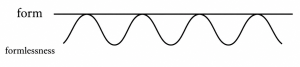
We tend to identify ourselves with the level of form, skimming across the surface of experience. Our solid egoic sense of self resides here. This is what we ordinarily take ourselves to be, yet it represents only one half of our existence. In psychoanalytic terms, the formless ground of experience corresponds to the unconscious. It is no less a part of us than the ego. The model can therefore be expressed as follows:
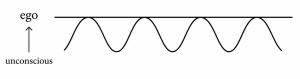
Our ego is a constellation of psychological habits, behavioural patterns, and projections that serves a largely defensive function. It attempts to manage what emerges from the unconscious, shielding us from painful or unsettling feeling states. These avoidant strategies distance us from our emotional life and create a discordance between what is arising from the unconscious and our conscious sense of self. We become unbalanced, out of alignment with the core of our being, and suffer as a consequence. Fearing what lies beneath, we may go to great lengths to protect ourselves. Much of our psychological turmoil arises from this defensive relationship with the unconscious.
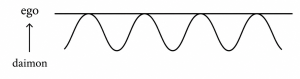
My proposal is simple. I suggest that the primordial essence of this formless unconscious ground is our personal daimon. It is the other half of ourselves that knows our place in the world and continually guides us towards our true home. This deepest aspect of our being knows us better than we know ourselves. It remembers our true calling—the choice we made before incarnation. The model therefore becomes:
Beyond Good and Evil
One might ask: why does our daimonic other half allow us to suffer?
There is no simple answer. I am mindful of not wanting to diminish the reality of human pain. Nevertheless, I believe that suffering itself is not the problem; rather, it is our relationship to suffering. If we regard suffering as purely negative—or even evil—we miss its message.
If our suffering has meaning, it loses some of its sting and becomes an invitation. If I feel low, disconnected, depressed, or restless, what is this experience asking of me? What am I avoiding? What part of myself longs to be acknowledged? What change is asking to happen?
When we heed the call of suffering, it becomes an opportunity for growth. The process may be long and painful, but it gradually makes us more compassionate, grounded, wise, and fully human. This is one of the ways the daimon speaks.
The daimon is as natural as the weather, with its countless moods. We cannot judge the weather as inherently good or bad; it simply is. Sometimes it nourishes the earth, and sometimes it destroys. Yet even destruction becomes part of a larger ecology of renewal. A tree felled in a storm creates space for new growth.
The Daimon in Psychotherapy: The Path of Surrender
There is no formula for reconnecting with our other half. This approach begins with the recognition that each person has a unique path. Any claim to know what is definitively best for another inevitably arises from ego.
Ultimately, people must find their own way. My role is simply to provide a space that facilitates this process.
I do this through a practice of non-doing rather than doing. It involves relaxing into the process rather than directing it. I rest in not knowing and trust that the process unfolds according to its own intelligence. In one sense, it is not I who performs the therapy; rather, I place my trust in our mysterious other half.
The daimon is not something the mind creates. It is already present. I do not have to manufacture it; I simply acknowledge its existence.
Consequently, I adopt a kind of double vision. I see the person's outer presentation while simultaneously recognising that something much deeper is at work. The only way I can do this is by resting in the core of my own being, embodying, as fully as possible, my own daimonic depths. This requires me to feel what needs to be felt and, when necessary, remain present with discomfort. Acting from this place, the therapeutic process unfolds naturally in its own rhythm. From one perspective, I do very little beyond relaxing my own being and opening myself to the feeling tones and textures of the other.
Surrendering to the nature of what is carries us downwards into the depths of our being. Therapy takes place in the space between form and formlessness, where the ego meets its heavenly counterpart. As we descend, solidity gives way to subtlety. We begin working with symbolic forms and living energies that are less fixed and more difficult to grasp. Here we discover the impersonal forces that course through us from the depths. This is the imaginal realm that underlies all experience. It is the archetypal field from which our psychological life emerges.
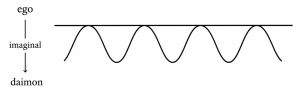
Therapy proceeds by bringing awareness beneath the level of the ego. Dreams and somatic experience can both serve as gateways into this realm. Each requires a descent—a fundamental surrender to what lies beneath conscious identity.
Here, in this underworld, we encounter the shadow: the grief, rage, shame, and anguish from which we have spent our lives protecting ourselves. Yet from the perspective of the personal daimon, these very feelings seek expression, transformation, and integration.
By patiently working with these painful energies, we gradually rediscover our true home—a place of comfort and ease within ourselves. Our struggles begin to reveal their meaning, and we slowly become more fully who we are. As inner peace deepens, our outer lives often begin to reorganise around it. We cease struggling against the flowing current of experience and instead move with it. In doing so, we approach the place that is both our destiny and our birthright.
This journey demands patience, courage, and surrender. It is the deepest form of self-discovery, and perhaps the most natural journey we can undertake.